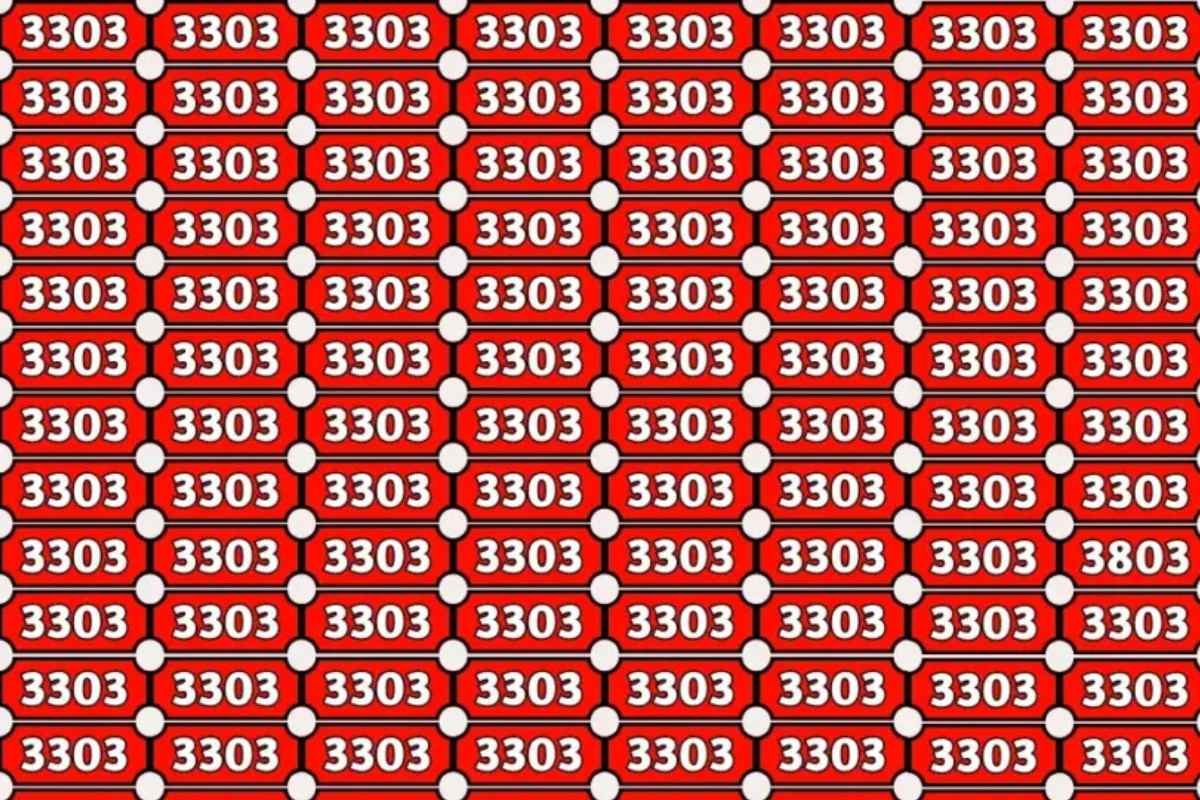
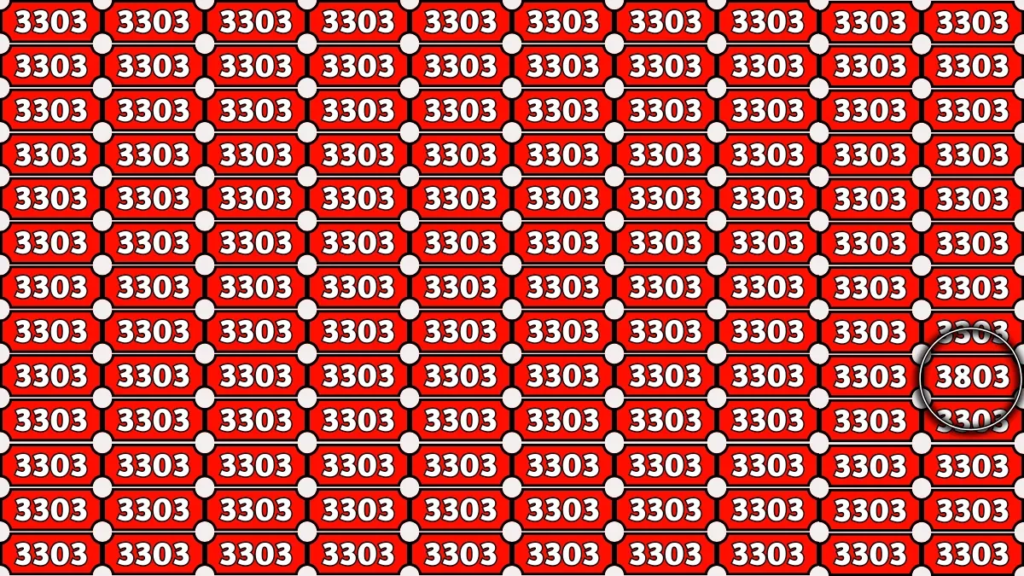
Optical illusion puzzles are one of the simplest and most effective ways to see how sharp your mind is. They appear simple at first, but once you start searching, your brain realizes it has work to do. This 6 second optical illusion IQ test asks you to find the number 3803 hidden among a grid of 3303s. The difference is small, the time is limited, and the pressure makes it even more difficult to concentrate. That is exactly what makes this puzzle so appealing to people of all ages.
Why This 6 Second Optical Illusion Feels Difficult
At first glance, the grid appears to be uniform. The repeated pattern 3303 tricks your brain into thinking all numbers are the same. When that assumption sinks in, your eyes stop scrutinizing each digit carefully. This illusion works because the numbers have the same structure, with only one digit changing in the middle.
The time limit also plays an important role. Six seconds seems like enough time until you attempt the challenge. Under time constraints, the brain prioritizes speed over accuracy. Instead of scanning carefully, it moves quickly across the image, frequently missing the one number that does not belong.
How the Brain Gets Fooled by Similar Numbers
The human brain is designed to recognize patterns quickly. This ability is useful in everyday life, but it becomes a weakness when performing optical illusions. In this puzzle, your brain focuses on the repeated 3s and stops expecting anything else. Even though the number 3803 includes an 8, your mind may interpret it as another 3303 without realizing it.
This occurs because the brain processes information in chunks rather than single details. When numbers appear almost identical, the brain fills in the gaps based on what it expects to see. Optical illusion puzzles take advantage of this habit, transforming simple digits into a true mental challenge.
Best Way to Spot 3803 Quickly
If you struggled to find the number within six seconds, there are a few tricks that can help next time. One effective method is to stop reading the full number. Instead, focus only on the middle digits. In this case, train your eyes to search for an 8 rather than scanning the entire grid for 3803.
Another effective strategy is to divide the image into sections. Scan from left to right or top to bottom in an organized fashion. Random scanning frequently misses minor differences. Staying calm is also more important than people realize. Tension narrows your vision, whereas relaxed focus allows details to stand out.
Why Optical Illusion IQ Tests Are So Popular
Puzzles like this one are popular everywhere because they are quick, entertaining, and competitive. You do not require any special skills or prior knowledge. All you need is a few seconds and a spark of curiosity. People enjoy challenging themselves and their friends to see who can solve it the fastest.
Their popularity is also due to their ability to provide immediate satisfaction. When you finally find the hidden number, you get a small rush of excitement. Your brain enjoys the moment of success, even if it took longer than expected. That feeling keeps people returning for more challenges.
What This Puzzle Says About Your Focus
Finding 3803 among the 3303s is about more than just intelligence. It is more about your ability to pay attention, be patient, and handle pressure. Some people notice it right away because they have a natural eye for small details. Others take longer but still succeed after slowing down and adjusting their strategy.
These puzzles demonstrate how easily the brain can be misled when it makes too many assumptions. They remind us that careful observation is often more important than speed, even when the clock is ticking.
Solution to the 6 Second Optical Illusion
If you couldn’t find the solution, here it is. The number 3803 is in the lower right corner of the grid. It stands out due to the single 8 sandwiched between the 3 and 0. Once you see it, the difference is obvious, and you may wonder how you missed it at first.
That sudden clarity is a common feature of optical illusions. Your brain switches from automatic pattern reading to focused observation, and everything makes sense right away.
How These Puzzles Help Train the Brain
Regular practice with optical illusion puzzles can help improve concentration and visual awareness. They encourage you to slow down, question your first impressions, and look more closely. Over time, this habit can also help you notice small details in everyday situations.
These challenges are also an excellent way to give your brain a quick workout without becoming bored. Whether you solve it in six seconds or sixty, your mind is constantly learning new things. Try more of these puzzles and see how your speed and accuracy improve with practice.