In modern football, defensive success is no longer defined solely by deep blocks or last-ditch tackles. One of the most effective tactical tools today is the defensive pressing trap—a coordinated strategy designed to lure opponents into specific areas of the pitch and then aggressively close space to force mistakes. When executed correctly, pressing traps disrupt rhythm, limit passing options, and lead directly to turnovers in dangerous zones.
What a Defensive Pressing Trap Really Is
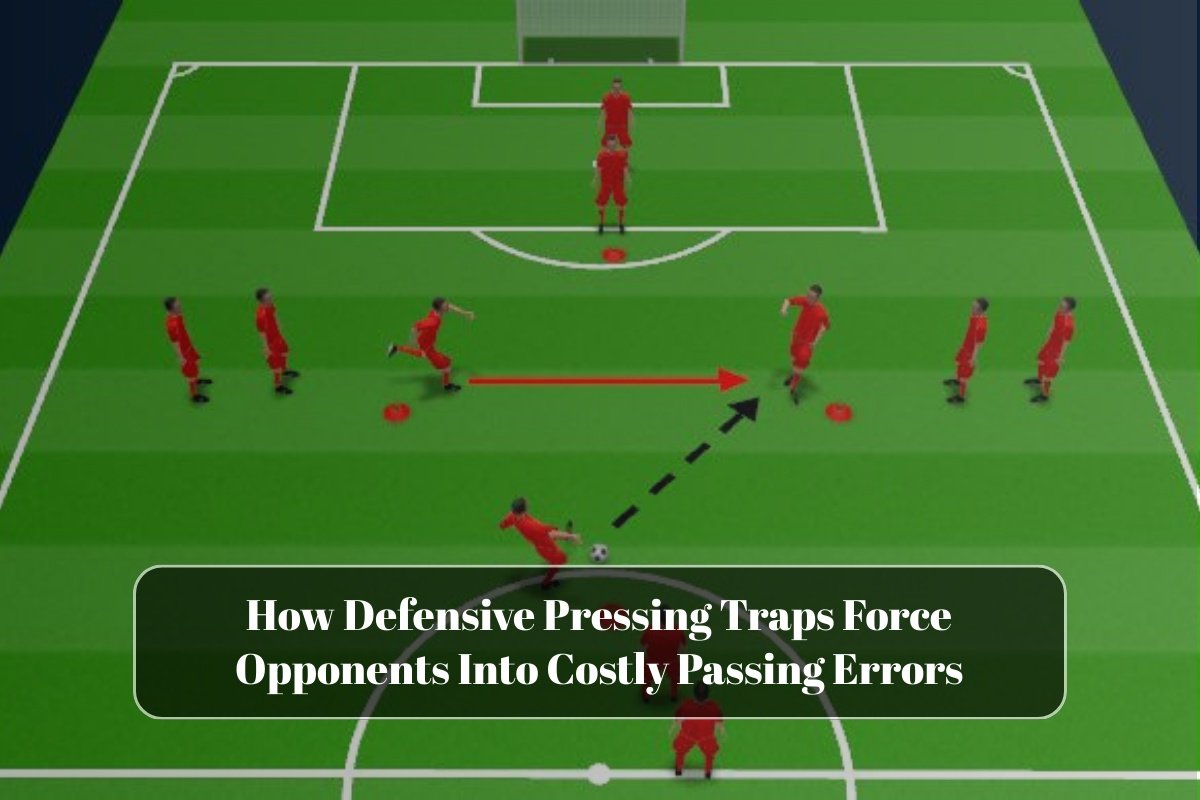
A defensive pressing trap is not random pressure. It is a pre-planned defensive scheme where players intentionally allow certain passes or spaces, knowing that once the ball enters that zone, multiple defenders will converge simultaneously.
The goal is to:
- Control where the opponent plays
- Limit passing angles
- Reduce decision-making time
- Force rushed or inaccurate passes
This turns possession into a liability rather than an advantage.
Why Pressing Traps Create Passing Errors
Passing accuracy depends on time, space, and clear options. Pressing traps are designed to remove all three at once.
When a trap is activated:
- Passing lanes are blocked
- The ball carrier is surrounded
- Teammates are marked tightly
- Pressure arrives from blind angles
The opponent is forced into low-percentage passes, often leading to interceptions or turnovers.
Using the Touchline as a Defensive Weapon
One of the most common pressing traps uses the touchline. By allowing the ball to move wide, defenders reduce the field horizontally.
In wide traps:
- The sideline acts as an extra defender
- The ball carrier loses escape routes
- Backward passes are anticipated
- Forward passes become risky
This setup dramatically increases the likelihood of misplaced passes or hurried clearances.
Forcing Play Into Predictable Zones
Effective pressing traps rely on predictability. Defenders guide opponents into areas where pressure can be applied most efficiently.
Common trap zones include:
- Wide channels near the halfway line
- Central midfield pockets with limited angles
- Fullback receiving zones under pressure
- Defensive third build-up lanes
When attackers are funneled into these zones, their options shrink rapidly.
Cutting Passing Lanes Before Pressing the Ball
A key principle of pressing traps is that the press starts away from the ball. Defenders first position themselves to block nearby passing options.
This creates:
- Isolation of the ball carrier
- Visual pressure that limits awareness
- Hesitation in decision-making
By the time direct pressure arrives, the ball carrier is already trapped.
Coordinated Team Movement Is Essential
Pressing traps only work when the entire defensive unit moves together. One late or disconnected player can break the trap instantly.
Successful pressing requires:
- Synchronized forward movement
- Compact vertical and horizontal spacing
- Clear communication
- Trust in teammates’ positioning
This coordination forces errors without reckless chasing.
Speed of Pressure Disrupts Technique
Even technically gifted players struggle when pressured at speed. Pressing traps aim to close space rapidly rather than gradually.
Fast pressure:
- Prevents clean body positioning
- Disrupts first touches
- Forces passes with poor balance
- Increases likelihood of mis-hits
Errors occur not because players lack skill, but because time disappears.
Psychological Pressure Amplifies Mistakes
Pressing traps also create mental stress. Players begin to anticipate pressure even before it arrives.
This leads to:
- Rushed decisions
- Overthinking simple passes
- Fear of losing possession
- Declining confidence in buildup play
As pressure builds, mistakes become more frequent.
Traps Are Designed for Transition Moments
Many pressing traps are triggered immediately after a loss of possession. Opponents are often unbalanced during these moments.
This makes them vulnerable to:
- Blind-side pressure
- Poor spacing
- Limited support options
Winning the ball here often leads to instant attacking opportunities.
Midfield Traps Target Decision Hubs
Midfielders act as passing hubs. Pressing traps that target central midfield aim to cut the opponent’s connection between defense and attack.
When midfield hubs are trapped:
- Build-up play stalls
- Passing tempo drops
- Long, hopeful passes increase
- Possession becomes inefficient
This forces turnovers or low-quality distribution.
Pressing Traps Reduce Opponent Control, Not Just Possession
The objective of pressing traps is not simply to win the ball, but to control how the opponent plays.
Even when possession is retained, traps often force:
- Backward passes
- Lateral circulation
- Long clearances
- Reduced attacking creativity
Control replaces chaos as the defending team dictates play.
Risk Management Within Pressing Traps
Well-designed pressing traps balance aggression with security. Defenders maintain cover positions to prevent being bypassed.
This includes:
- Staggered defensive lines
- Cover shadows behind the press
- Recovery positioning
As a result, traps create pressure without exposing the defense.
Why Pressing Traps Are Central to Modern Football
Modern football emphasizes space control over constant tackling. Pressing traps align perfectly with this philosophy.
They:
- Maximize defensive efficiency
- Reduce physical overexertion
- Create attacking chances from defense
- Force repeated opponent errors
Teams that master pressing traps often dominate territory and tempo.
Errors Become Inevitable, Not Accidental
When pressing traps are executed consistently, passing errors are no longer accidental—they are inevitable outcomes of pressure, space denial, and coordination.
Opponents are not beaten by force alone, but by structure, intelligence, and collective movement.
Frequently Asked Questions (FAQ)
Q. Are pressing traps the same as high pressing?
No. Pressing traps can occur high, mid, or low on the pitch and are based on positioning, not constant pressure.
Q. Do pressing traps require high fitness levels?
They require smart movement more than nonstop running, making them efficient when executed properly.
Q. Can pressing traps work against technical teams?
Yes. Even technical teams struggle when time and space are removed simultaneously.
Q. What breaks a pressing trap?
Quick one-touch passing, accurate long switches, and individual dribbling can escape traps.
Q. Are pressing traps risky defensively?
They carry risk if poorly coordinated, but well-structured traps include built-in defensive cover.