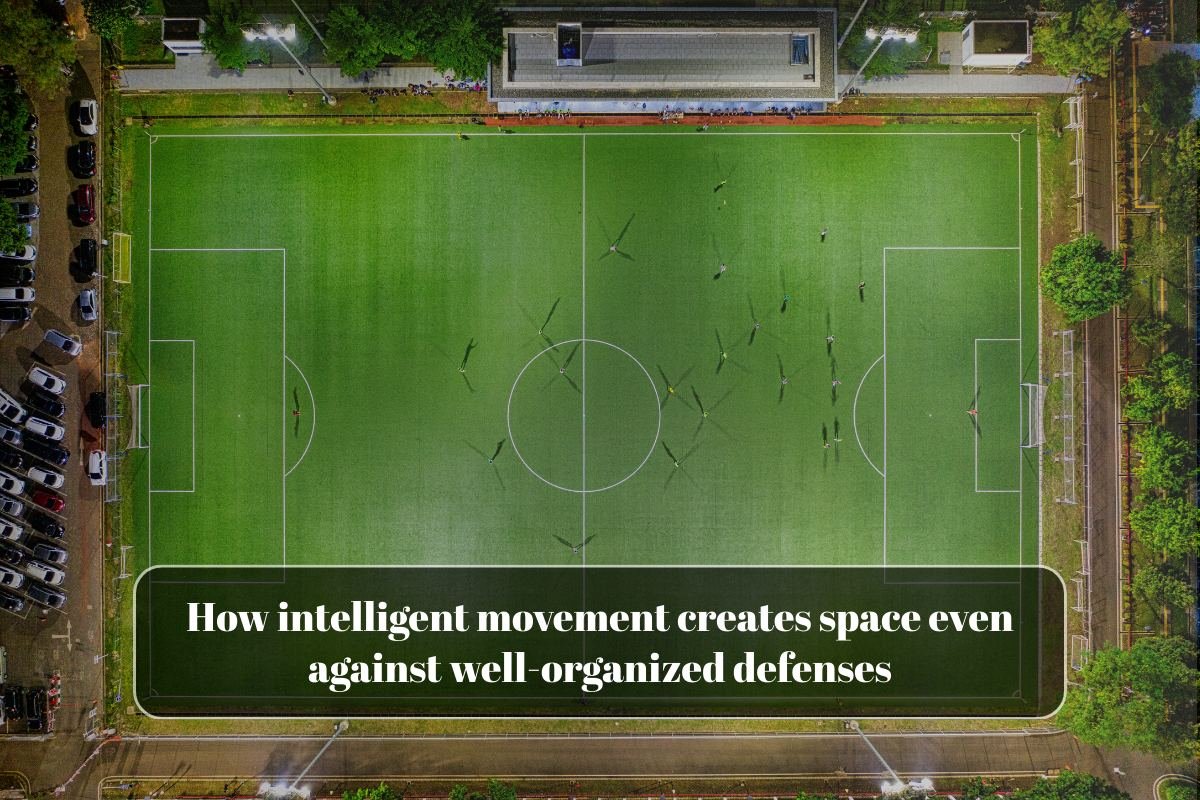
In modern football, space is the most valuable resource on the pitch—and the hardest to find. As defenses become more compact, structured, and tactically disciplined, breaking them down no longer depends solely on speed or individual dribbling. Instead, intelligent movement has become one of the most effective tools for creating space, even against the most organized defensive units.
Understanding Space as a Dynamic Concept
Space in football is not static; it constantly appears and disappears based on player movement. Well-organized defenses aim to reduce space by staying compact vertically and horizontally. However, every defensive structure relies on coordination and reference points. Intelligent attacking movement disrupts those reference points, forcing defenders to make decisions that momentarily open passing lanes or channels.

Rather than waiting for space to appear, top players create it through timing, angles, and deception. Movement without the ball is often more decisive than actions on it.
Off-the-Ball Runs That Manipulate Defenders
One of the simplest yet most powerful tools is purposeful off-the-ball movement. Runs are not always meant to receive the ball. Decoy runs pull defenders out of position, stretch defensive lines, and create space for teammates.
For example, a forward making a diagonal run toward the near post can drag a center-back with them, opening a pocket of space at the top of the box for a midfielder arriving late. These movements force defenders to choose between maintaining shape or tracking runners—either decision creates vulnerability.
Timing: Moving at the Right Moment
Intelligent movement is as much about when as where. Poorly timed runs are easy to defend, even if the idea is correct. Elite attackers read cues such as a teammate’s body shape, a defender stepping forward, or a momentary loss of balance in the defensive line.
By delaying a run by a split second, attackers stay onside, avoid markers, and arrive into space uncontested. This synchronization between passer and mover is what allows teams to penetrate compact blocks without relying on risky passes.
Creating Overloads and Rotations
Against organized defenses, numerical superiority in specific zones is crucial. Intelligent movement enables positional rotations and overloads that confuse marking responsibilities. When players interchange positions fluidly, defenders are forced to communicate constantly and may hesitate over who should step out.
For instance, when a winger moves inside while a fullback overlaps, defenders must decide whether to pass runners on or follow them. Even brief hesitation can be enough to create a passing lane or crossing opportunity.
Using Blind-Side and Between-the-Lines Movement
Well-organized defenses rely heavily on visual awareness. Intelligent attackers exploit this by positioning themselves on defenders’ blind sides or between defensive lines. A player who constantly adjusts their position just outside a defender’s field of vision is far harder to track.
Between-the-lines movement—finding pockets between midfield and defense—forces defenders to step out, breaking compactness. When one defender steps forward, gaps inevitably appear elsewhere, creating chain reactions that attackers can exploit.
Movement That Accelerates Ball Circulation
Smart movement does not only create space for the mover—it speeds up the entire attack. When players offer clear passing options through angles and distances, the ball moves quicker. Fast circulation shifts defensive blocks side to side, eventually stretching them beyond recovery.
This is why teams with strong off-the-ball movement often appear to “play through” defenses effortlessly. The space was not obvious at first—it was manufactured through coordinated motion.
Why Intelligent Movement Matters More Than Ever
As tactical analysis and defensive coaching advance, space becomes increasingly scarce. Individual brilliance still matters, but it is intelligent collective movement that consistently unlocks disciplined defenses. Players who understand spacing, timing, and purpose can influence the game even without touching the ball.
Ultimately, intelligent movement is a form of problem-solving. It turns rigid defensive organization into uncertainty, transforms structure into chaos, and allows attacking teams to create opportunities where none seemed to exist.
FAQs
What is intelligent movement in football?
It refers to purposeful, well-timed off-the-ball actions that manipulate defenders and create space for teammates or oneself.
Can movement without the ball really be more important than dribbling?
Yes. Against organized defenses, movement often creates clearer chances than individual dribbling.
How do players learn intelligent movement?
Through tactical coaching, game understanding, repetition, and watching how teammates and opponents react.
Why do decoy runs matter if the player doesn’t get the ball?
Decoy runs disrupt defensive shape and create space for others, making them crucial to team attacking play.
Is intelligent movement only important for attackers?
No. Midfielders and even defenders use movement to create passing angles, progress the ball, and maintain team structure.