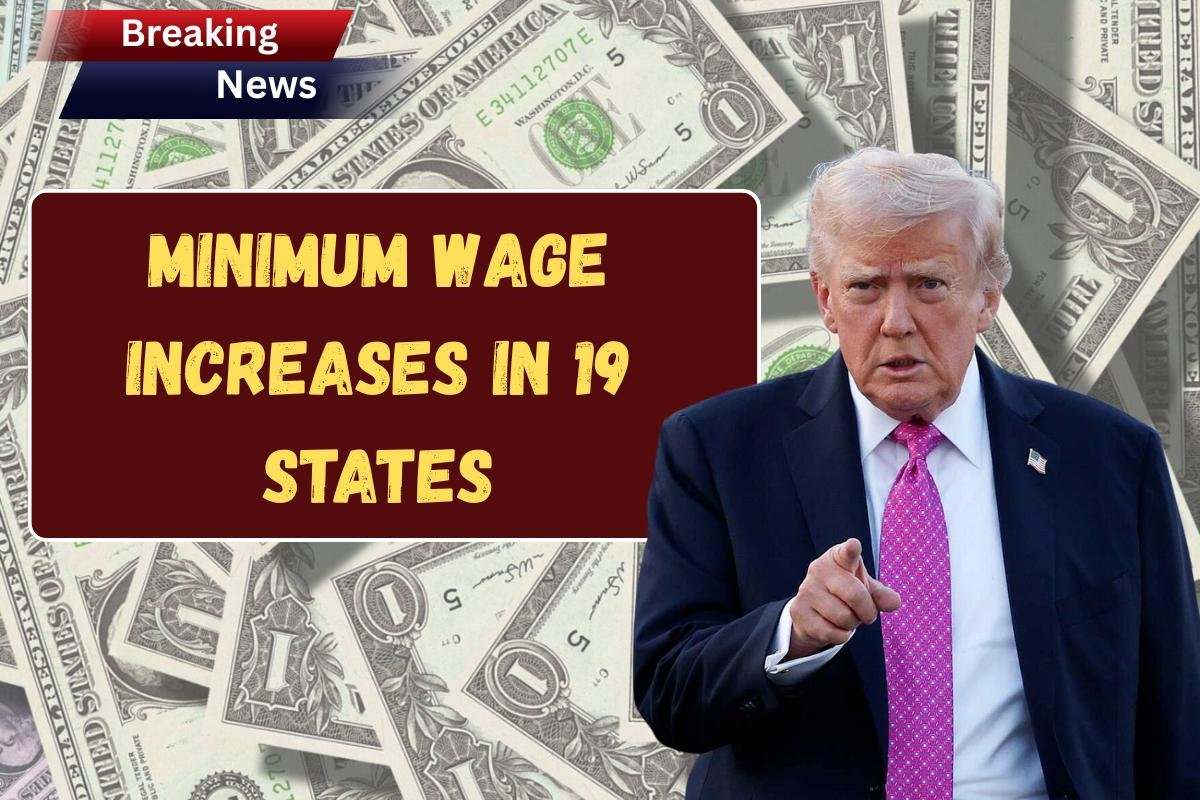
The new year is arriving with a quiet but meaningful raise for millions of workers across the country. While most people are still shaking off holiday schedules and unopened credit card bills, paychecks in 19 states will start looking a little heavier on Jan. 1, 2026, thanks to automatic minimum wage increases tied to inflation or voter-approved laws.
This year marks a psychological shift as much as a financial one. For the first time, more states will have a minimum wage at or above $15 an hour than those still stuck at the federal floor of $7.25, according to the Economic Policy Institute. That federal rate hasn’t budged since 2009, a fact that continues to shape the national debate over wages, jobs, and affordability.
States Crossing the $15 Threshold for the First Time

Six states will officially move past the $15-an-hour mark when the calendar flips to 2026: Arizona, Colorado, Hawaii, Maine, Missouri, and Nebraska. For workers in these states, this isn’t just a symbolic win. In many cases, it represents a multi-year climb driven by ballot initiatives or state laws designed to keep wages from falling behind rising costs.
Hawaii’s increase stands out. The state will see its minimum wage jump from $14 to $16 per hour on Jan. 1, the largest statewide increase in the country this year. That hike is part of a scheduled path toward $18 an hour by 2028, approved by lawmakers in response to the state’s exceptionally high cost of living.
According to Ballotpedia, the average increase among states raising wages at the start of 2026 is about 70 cents per hour. That may not sound dramatic, but over a full-time year, it can translate into roughly $1,400 more in pay before taxes.
Where Minimum Wages Are Already the Highest

Several states that already sit well above $15 an hour are also getting inflation-adjusted boosts.
Washington state’s minimum wage will rise to $17.13 per hour, up from $16.66, keeping it among the highest statewide rates in the nation. Connecticut will move to $16.94, while California’s general minimum wage will increase to $16.90 per hour.
Here’s how some of the top rates stack up going into 2026:
| State / District | 2026 Minimum Wage | Previous Rate |
|---|---|---|
| Washington | $17.13 | $16.66 |
| Connecticut | $16.94 | $16.35 |
| California | $16.90 | $16.50 |
| Hawaii | $16.00 | $14.00 |
| District of Columbia | $17.95 | $17.95 (July 2025) |

The District of Columbia still holds the crown with a minimum wage of $17.95 per hour, which took effect in July 2025 under the city’s inflation-indexed law. D.C. isn’t scheduled for another automatic increase until July 2026, but that hasn’t stopped advocates from pushing for more.
Ballot Fights and the Push for $25 an Hour
In Washington, D.C., labor groups are campaigning for a November ballot initiative that would raise the minimum wage to $25 per hour and eliminate the tipped wage credit entirely. If approved, it would be one of the most aggressive wage mandates in the country, and a test case for how far voters are willing to go amid ongoing inflation concerns.
California is also a wildcard. The state already implemented a $20-per-hour minimum wage for fast-food workers in 2024, a first-of-its-kind policy overseen by a special council. That wage is eligible for an inflation adjustment in 2026, but the council has been effectively dormant as it awaits the appointment of a new chair. Whether that adjustment happens on schedule remains an open question.
More details on state wage laws and adjustments can be found through the U.S. Department of Labor at https://www.dol.gov/agencies/whd/minimum-wage, as well as state-level data compiled by Ballotpedia at https://ballotpedia.org/Minimum_wage.
The States Still at $7.25
Even as more states cross $15, a significant chunk of the country remains anchored to the federal minimum wage of $7.25 per hour. Twenty states continue to default to that rate, meaning workers there will see no automatic raise in 2026 unless their city or county has its own local ordinance.
The federal minimum wage hasn’t increased since 2009, despite repeated attempts in Congress to raise it. According to the U.S. Bureau of Labor Statistics, $7.25 today has roughly 30% less purchasing power than it did when it was last raised, a gap that fuels much of the current policy debate.
Critics Say Higher Wages Cost Jobs
Not everyone is cheering these increases.
Researchers at the Employment Policies Institute, a conservative-leaning think tank, argue that the wave of minimum wage hikes inspired by the Fight for $15 movement between 2011 and 2019 had unintended consequences. A report co-authored by economists Jeffrey Clemens and Michael Strain found that higher minimum wages reduced employment rates among low-experience and low-education workers by more than 2.5 percentage points.
Rebekah Paxton, EPI’s research director, was blunt in a statement responding to the new round of increases. “This new study confirms what the vast majority of economists, workers and businesses have known for years,” she said. “Steep wage hikes kill jobs, reduce employment opportunities and shutter businesses.”
Supporters of this view argue that small businesses, especially in retail and food service, struggle to absorb higher labor costs and may respond by cutting hours, raising prices, or delaying hiring.
Business Groups That Support Higher Minimum Wages
On the other side of the debate is a growing coalition of employers who say higher wages actually help their bottom line.
Business for a Fair Minimum Wage, a national network of business owners, welcomed the Jan. 1 increases. The group argues that better pay reduces employee turnover, improves morale, and puts more money into local economies.
“Wage increases are a vital part of the solution to the affordability crisis,” said Holly Sklar, CEO of Business for a Fair Minimum Wage. “The cost of food, housing and other necessities has risen sharply. Minimum wage increases boost the economy as workers are better able to afford necessities and spend more at local businesses.”
Their argument is backed by studies from institutions like the Brookings Institution and the Federal Reserve, which have found mixed but often modest employment effects from gradual, predictable wage increases, especially when they’re tied to inflation rather than sudden jumps.
What This Means for Workers and Employers in 2026
For workers in states seeing increases, the changes won’t suddenly solve the affordability crisis. Rent, groceries, and insurance costs have risen faster than wages in many regions. Still, an extra 50 to 75 cents an hour can mean fewer tough choices at the end of the month.
For employers, especially those operating across state lines, 2026 will require careful payroll planning and compliance checks. Wage laws are increasingly fragmented, with different rates for cities, industries, and tipped workers layered on top of state minimums.
The broader trend is clear, though. While federal action remains stalled, states and cities are continuing to push wages higher, often automatically, year after year. Whether that momentum eventually forces Congress to revisit the federal minimum wage is the question hanging over all of this.
For now, Jan. 1 will quietly deliver a raise to millions of workers. Not a revolution, maybe, but another step in a long-running economic experiment that shows no signs of slowing down.
FAQs
1. How many states are raising the minimum wage on Jan. 1, 2026?
Nineteen states will increase their minimum wage at the start of 2026.
2. What is the highest minimum wage in the U.S.?
The District of Columbia currently has the highest minimum wage at $17.95 per hour.
3. How many states still use the federal minimum wage?
Twenty states still default to the federal minimum wage of $7.25 per hour.
4. Why do some states raise wages automatically each year?
Many states tie their minimum wage to inflation to prevent purchasing power from eroding over time.
5. Do higher minimum wages always reduce jobs?
Research is mixed. Some studies find reduced employment for certain groups, while others find minimal effects and benefits like lower turnover.