Modern football is shaped as much on the training ground as it is on match day. Behind today’s pressing traps, positional rotations, and data-led conditioning are decades of experimentation, rebellion, and quiet revolutions. Many of football’s most influential training movements were born not from textbooks, but from necessity, frustration, and visionary coaches willing to challenge convention.
The Birth of Total Football: Training Without Positions
Total Football is often remembered as a tactical philosophy, but its real innovation lived in training. At Ajax and the Dutch national team in the late 1960s and 1970s, Johan Cruyff and his coaches demanded sessions where players constantly swapped roles. Defenders learned to attack, forwards tracked back, and midfielders became spatial conductors.

What’s less discussed is how chaotic these sessions initially felt. Players were deliberately put in uncomfortable situations, forced to think rather than react. Mistakes were encouraged because adaptability was the end goal. This training culture laid the groundwork for modern positional play and shaped how academies now prioritize intelligence over rigid specialization.
Pressing as a System: From Risk to Religion
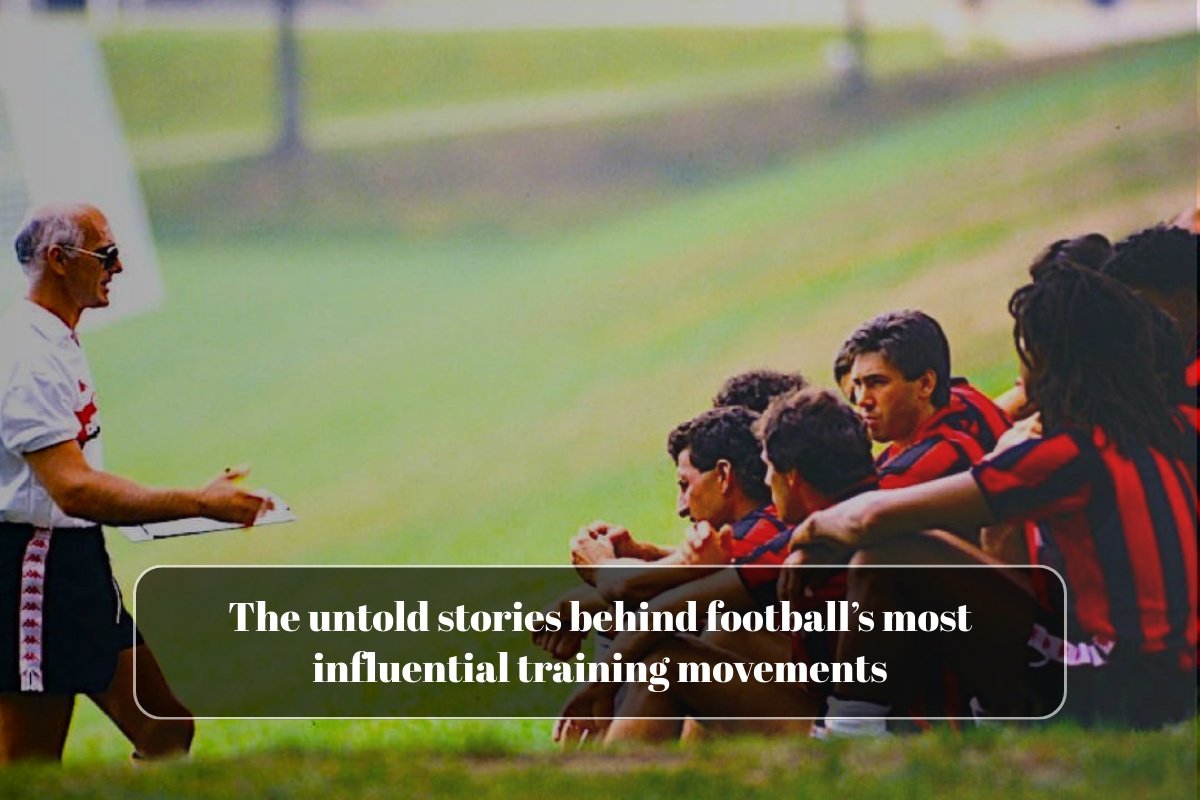
High pressing didn’t become fashionable overnight. In the late 1980s, Arrigo Sacchi shocked Italian football by training AC Milan to defend without man-marking. His sessions famously involved rehearsing defensive shape without a ball, drilling synchronized movement again and again.
The untold story is how controversial this was. Players initially questioned why elite professionals were running shadow drills like amateurs. But Sacchi believed repetition built collective instinct. His methods redefined pressing not as effort, but as coordination. Today’s gegenpressing systems owe a direct debt to those ball-less Milan training sessions.
Small-Sided Games: The Street Football Revival

Small-sided games are now standard in elite training, but their roots are deeply informal. Coaches in South America and Southern Europe realized that the creativity seen in street football was disappearing under rigid drills. Their response was to shrink the pitch, limit touches, and overload spaces.
The hidden power of these sessions wasn’t fitness—it was decision-making speed. In tight spaces, players learned to scan constantly and solve problems instinctively. What began as an attempt to preserve flair evolved into one of the most effective tools for tactical and cognitive development in modern football.
Periodization and the Science Takeover
As football became faster, training had to become smarter. Tactical periodization emerged from the belief that fitness, tactics, and psychology should never be trained separately. Instead of isolated running sessions, everything was done with the ball and within a tactical context.

This movement quietly changed the weekly rhythm of football. Recovery, intensity, and mental load were planned with surgical precision. While fans saw fresher teams on match day, the real revolution happened behind closed doors, where training sessions became reflections of the game itself rather than preparation adjacent to it.
The Relentless School of Intensity
Few coaches embody obsessive training intensity like Marcelo Bielsa. His training sessions are legendary for their length, detail, and physical demands. What’s often missed is that Bielsa’s intensity wasn’t about punishment—it was about clarity.
Every drill mirrored a specific match scenario. Players repeated movements until they became automatic. Many struggled under the load, but those who thrived gained a deep understanding of space, timing, and collective responsibility. Bielsa’s influence can now be seen across pressing-heavy teams worldwide.
From Rebellion to Blueprint
The most influential training movements in football history began as acts of defiance. Coaches challenged norms, players questioned methods, and results were uncertain. Over time, these ideas became blueprints copied across academies and continents.
Football training continues to evolve, but its biggest leaps still come from those willing to rethink how players learn, not just how they run.
FAQs
What is the most influential football training movement of all time?
Total Football is often considered the most influential because it reshaped how players are developed, emphasizing versatility, intelligence, and spatial awareness.
Why are small-sided games so effective in training?
They replicate match pressure in tight spaces, improving decision-making speed, technique, and tactical awareness simultaneously.
How did pressing become a structured training concept?
It evolved through coaches like Arrigo Sacchi, who trained collective movement and spacing rather than individual marking.
What is tactical periodization in simple terms?
It’s a training method where fitness, tactics, and mentality are trained together through game-like drills instead of separate sessions.
Are modern training methods replacing creativity?
When designed well, modern methods actually protect creativity by placing players in realistic, problem-solving situations rather than rigid patterns.