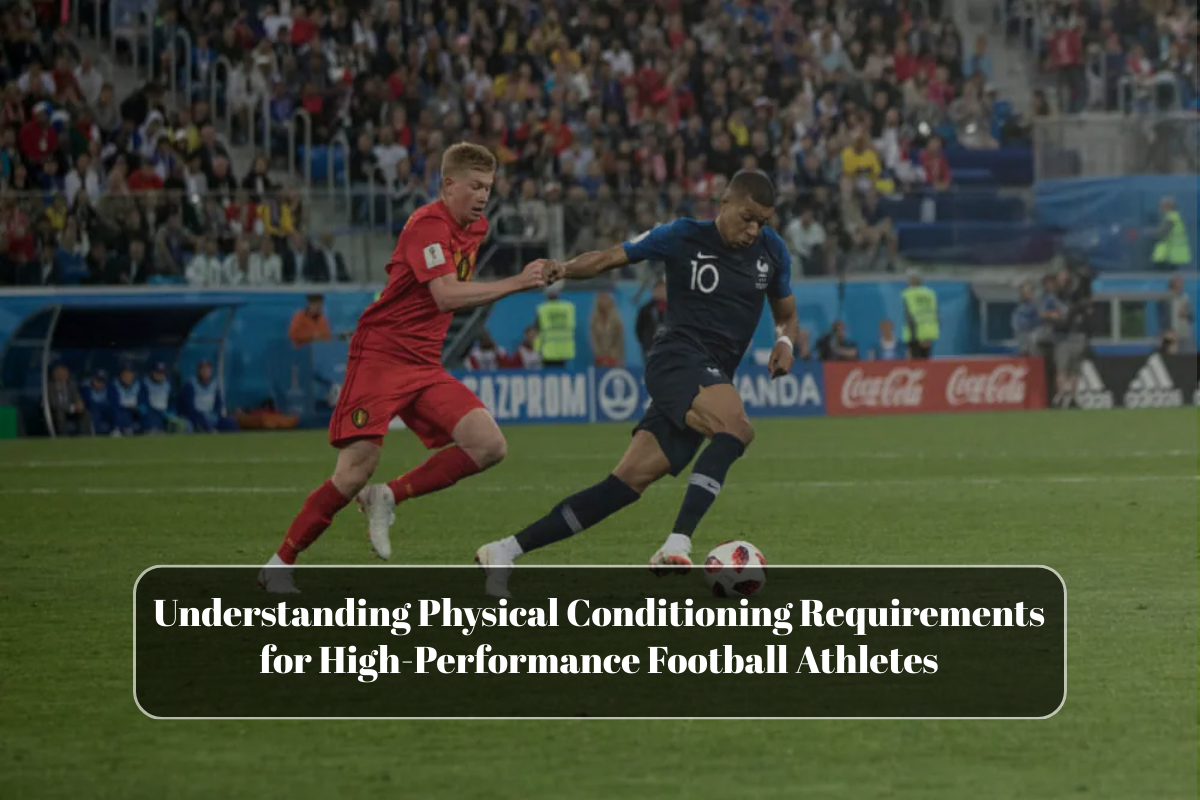
High-performance football athletes require multifaceted physical conditioning to meet the sport’s intermittent demands, covering 10-13 km per match with 1400+ activity changes every 4 seconds on average. Elite players sustain 80-90% max heart rate, blending aerobic endurance (VO2max 60-75 ml/kg/min), anaerobic power for sprints, and strength for duels, enabling repeated high-intensity efforts amid recoveries as short as 20 seconds for midfielders.
Aerobic Endurance: The Foundation of Match Stamina
Aerobic capacity powers 80-90% of energy needs, with top players hitting VO2max of 60-75 ml/kg/min—highest in midfielders (up to 62.8 ml/kg/min)—to cover distances and recover between bursts. Running economy and maximal aerobic speed (MAS) optimize efficiency, as players perform moderate-high intensity runs totaling 10-13 km, with central midfielders logging shortest recoveries (<20s).

Training emphasizes tempo runs, long-distance efforts, and HIIT mimicking match intermittency (e.g., 5-11 sets of 3-min runs >90% max), boosting glycogen stores and fatigue resistance. Elite benchmarks distinguish levels: professionals average 58-63 ml/kg/min, amateurs lower at 57.8 ml/kg/min.
Anaerobic Power and Speed: Explosive Actions
Anaerobic systems fuel 10-20% high-intensity efforts—sprints, accelerations, cuts—with players executing 1400 changes, including maximal sprints every 60-70s (1:12 work-rest ratio). Sprint speeds (20-30m) and anaerobic speed reserve (ASR = MSS – MAS) enable repeated max efforts; midfielders need superior repeatability.
Power metrics like peak power/kg body mass support jumps and shots; studies show high-aerobic players maintain anaerobic capability, with no trade-off in elite squads. Conditioning via HIIT, small-sided games, and plyometrics (box jumps, shuttle runs) builds this, as 30% ASR distance correlates with fitness gains.
Strength, Power, and Agility: Duel-Winning Attributes
Strength underpins tackling, shielding, and aerial wins, targeting lower body (squats, deadlifts) and core (planks, med-ball twists) for stability. Power—explosive force via cleans, kettlebell swings—enhances acceleration; agility ladders and duels improve change-of-direction for defenders/midfielders.
Position-specific: defenders prioritize eccentric loading and intercepts; attackers focus plyometrics for leaps. Elite players balance strength without bulk, as neuromuscular fatigue from mechanical loads demands recovery-focused programming.
Position-Specific Conditioning Demands
Data shows midfielders cover most high-intensity distance, attackers sprint farthest.
Integrated Training and Recovery Protocols

Weekly schedules blend gym (morning power/conditioning), pitch (afternoon tactics/HIIT), and recovery (evening mobility, sleep/nutrition). Off-season emphasizes max velocity runs and eccentric loading; in-season uses HIIT (3-5x/week) for maintenance. Injury prevention via flexibility, monitoring (e.g., Bronco test for MAS), and periodization sustains peaks.
Frequently Asked Questions (FAQ)
1. What VO2max distinguishes elite footballers?
60-75 ml/kg/min, with midfielders highest (62.8 ml/kg/min); amateurs average 57.8 ml/kg/min.
2. How does anaerobic capacity complement aerobic fitness?
No trade-off in elites—high VO2max players sprint faster/repeatedly, vital for 1:2-1:12 work-rest ratios.
3. Why position-specific training?
Midfielders need endurance + ball control; defenders agility for intercepts; demands vary by role’s locomotor profile.
4. How much HIIT for conditioning?
3-5 sessions/week: 5-11×3-min >90% max or small-sided games simulating intermittency.
5. How to measure progress?
Bleep/Bronco tests (VO2max/MAS), 20-30m sprints, ASR; track match high-intensity distance.